I
was born 1978, in Los Angeles California. My family emigrated
here from Honduras, like most families seeking a better
life. As a child I often felt lonely and haunted. I was
very shy and suffered from paranoia. I would feel like
someone was always watching or following me. I would scream
at my own shadow. When I was in high school I felt detached
and lacked interest in my peers. I wanted something to
relate to which I soon found in my art class so I quickly
picked up the basic skills and became an art student. I
was asked to participate in several art awareness projects
for the city of San Gabriel and graduated with a scholarship
from Bank of America for the arts. After high school I
went to Rio Hondo College in Whittier, CA. My desire to
create and pursue a career in art not only became my mission
in life but a necessity. After two years there I got my
Associates in the Arts degree, and decided to study art
abroad. I moved to Paris and attended the Sorbonne. I then
returned home and enrolled in the fine arts program at
the University of Fullerton. In 2004 I graduated. I had
my first invitation to show at an established gallery in
2004, and after that I’ve been asked to exhibit in
over 25 group shows since 1998. Since graduation I’ve
run a gallery on Gallery Row in downtown Los Angeles, curated
shows, including an upcoming exhibition in Tijuana, Mexico,
worked on entertainment productions, designed clothing
and accessories, interned at a fine arts print studio,
painted murals throughout California, contributed to help
fund a school for the arts in Honduras, collaborated with
legendary graffiti artists and taught art to children with
special needs. This is my first solo exhibition.
Melly Trochez
Some
people might misinterpret the act of painting oneself
as an act
of shallowness, self-
absorption or even an act that limits the artist from
being a social commentator. In Melissa Trochez’ case,
it is quite the opposite. Her unique ability to explore
the
vulnerable
depths of her emotions while engaging in intimate dialogue
with her audience ultimately concludes with a hopeful
optimism. One way to experience her work is to see it as
a series
that captures difficult, incomprehensible life events.
Eventually,
her works evolve from self-consciousness to hope and
social awareness.
This is most evident in her diary series, her
earliest body of work, which documents her growth and development
as
an artist. The unfinished sense one is left with reinforces
the idea that there is beauty in imperfection. This alludes
to the fact that she too is a work in progress. Much like
her eclectic characterizations which are often tainted
with a clash
of vibrant colors, her backgrounds are filled with unfinished
images that mimic the texture of scrapbooks. Some seem
to be cut from the front pages of magazines or handmade
quilts.
This
effect allows you to see the process of making art without
its pretentious makeup.
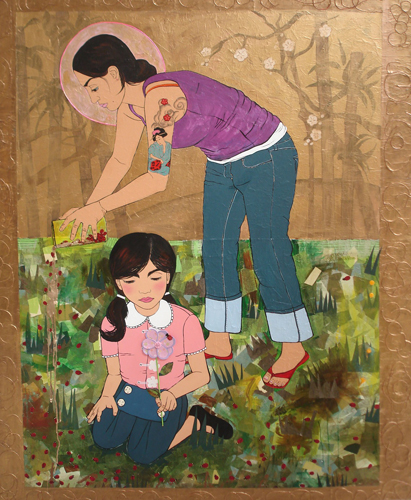
Her angel series, which is the
most disturbing yet hopeful series, brings the viewer into
an
abstract reality which is contradicting in nature. These
paradoxical
depictions cast shadows of hope through her beautiful sadness.
Innocently knowledgeable of questions instinctual to the
soul she engages in conversations with angels regarding
her protection,
hope, and survival. These romantic pieces are infused by
Catholic-pagan rituals, stoicism, and ominous imagery which
serve to comment
on the disappointments of religion.
Her flat series, like her diary series, represent her
transcendence from self-preoccupation to social- consciousness.
Here,
the audience is taken beyond her emotional dialogue
and is lead to a world of epiphanies and moral awakening. Within this animated,
primary coated series, the illusion of stagnancy is created through the
juxtaposition of comfortable hermits with distressed
characters in the background. These
conflicts foreshadow the immorality and guilt subtly
associated with materialism. Ultimately,
the three series of works leave you with a hopeful feeling that progress
can be achieved even when a person’s emotional
stability is questionable. Courageously, she provides
her audience
with something to believe in especially
for those who
have felt that everything has let them down.
By
Hugo Velazquez



 Melly
Trochez
Melly
Trochez